
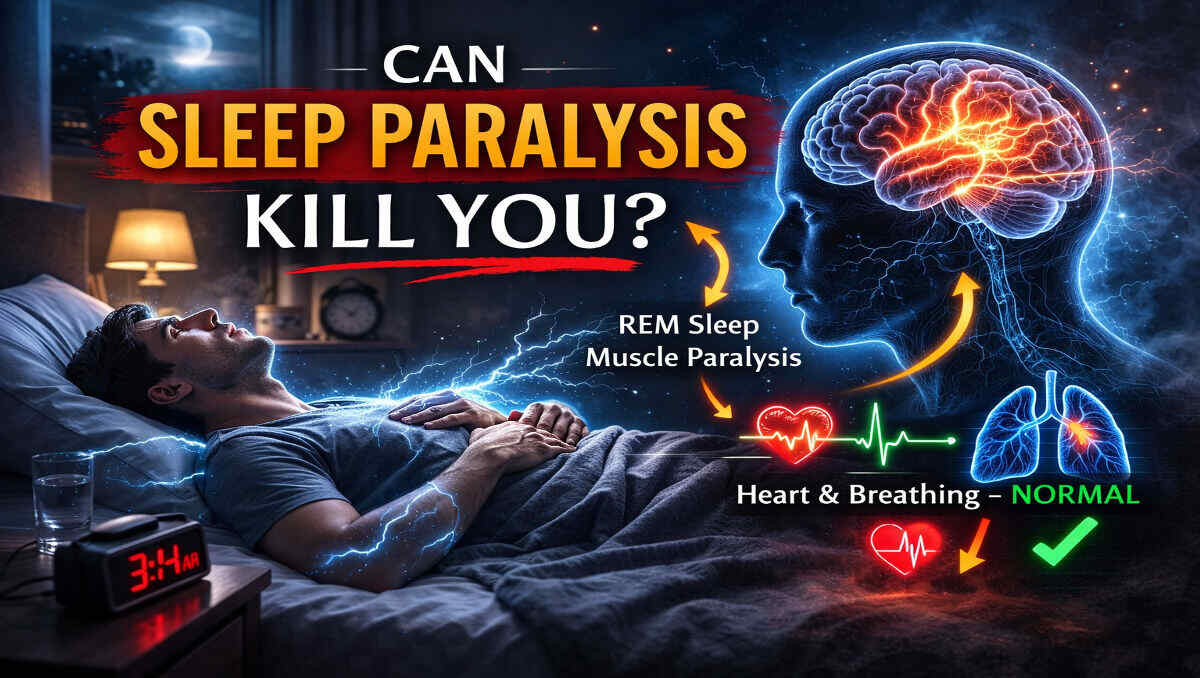
Can Sleep Paralysis Kill You? 9 Critical Medical Facts You Must Know
Can sleep paralysis kill you? This is one of the most frightening questions people ask after experiencing an episode. You wake up suddenly. Your eyes are open. You see your room clearly. But your body will not move. You try to speak, but no sound comes out. Your chest feels heavy. Your breathing feels restricted. Panic rises quickly. In that moment, it feels like something is very wrong. Some people believe they are dying. Others fear they are having a stroke or heart attack.
The experience feels intense because it happens during vulnerability. You are awake, but you cannot control your body. Fear makes the moment feel dangerous. However, feeling dangerous and being dangerous are not the same.
This article explains clearly and calmly whether sleep paralysis can kill you, why it feels life-threatening, what actually happens in the brain, and how to reduce episodes safely.
Direct Medical Answer: Can Sleep Paralysis Kill You?
Can sleep paralysis kill you? The clear medical answer is no. Sleep paralysis does not stop the heart. It does not stop breathing permanently. It does not cause brain damage. It does not lead to death.
Sleep paralysis is a temporary neurological state that occurs when the brain wakes up before muscle control returns during REM sleep. The body remains briefly in a sleep protection mode called REM atonia. This protective mechanism prevents you from acting out dreams.
During an episode, essential life functions such as heartbeat and breathing continue automatically. Even though breathing may feel restricted, the body continues to regulate oxygen safely.
The experience is frightening, but it is not fatal.
If you are new to this condition, it is important to first understand the neurological mechanism behind it. Before worrying about danger, read our detailed explanation on what is sleep paralysis, where we break down REM sleep, muscle atonia, and why awareness returns before movement.
Why It Feels Like You Are Dying
If sleep paralysis cannot kill you, why does it feel so intense? The answer lies in how the brain processes fear.
During sleep paralysis, part of the brain responsible for threat detection remains active. When movement is blocked and the chest feels heavy, the brain interprets this as danger. Adrenaline increases. Heart rate rises. Breathing may feel shallow. Panic amplifies the experience.
The chest pressure sensation occurs because voluntary chest muscles are temporarily inactive. However, automatic breathing muscles continue working. Oxygen levels remain stable.
The brain misinterprets the situation as life-threatening. The body is not in danger, but the fear response makes it feel that way.
Understanding REM Sleep and Muscle Paralysis
To fully answer can sleep paralysis kill you, we must understand REM sleep. REM stands for rapid eye movement. During REM sleep, the brain becomes active and dreaming occurs. To prevent injury from acting out dreams, the brain temporarily blocks signals to voluntary muscles. This state is called REM atonia.
According to the National Institute of Neurological Disorders and Stroke, REM sleep naturally includes temporary muscle inhibition to prevent dream enactment.
The American Academy of Sleep Medicine confirms that sleep paralysis is a temporary REM-related phenomenon and not a fatal condition.
REM atonia is protective. It keeps you safe during dreams.
Sleep paralysis happens when awareness returns before REM atonia switches off. The brain wakes first. The muscles wake slightly later. That short delay creates temporary immobility.
Once REM atonia ends, movement returns naturally.
This process is normal and not harmful.
How Long Does Sleep Paralysis Last?
Most episodes last between ten seconds and two minutes. Fear may make it feel longer. The episode ends when muscle signals resume. Sometimes focusing on small movements such as wiggling a finger or toe can help restore control faster.
Even without intervention, the body automatically corrects the state. It does not continue indefinitely.
Understanding duration helps reduce fear and directly addresses the question can sleep paralysis kill you. A short, self-correcting neurological delay cannot cause death.
Can Sleep Paralysis Stop Your Breathing?
Many people ask this because chest pressure feels intense. During REM atonia, voluntary muscle control is reduced. This includes some chest wall muscles. However, the diaphragm continues to function. The brainstem controls automatic breathing independently of voluntary muscle control.
Breathing may feel difficult, but oxygen flow continues.
Medical research shows that sleep paralysis does not cause respiratory failure in healthy individuals.
The sensation of suffocation is distressing, but it is not life-threatening.
Can Sleep Paralysis Cause Heart Problems?
During an episode, heart rate may increase because of fear. Anxiety triggers adrenaline release. Temporary heart rate elevation is a stress response, not a direct effect of paralysis.
There is no evidence that sleep paralysis causes heart attack or cardiac arrest in otherwise healthy individuals.
However, severe anxiety during episodes can feel overwhelming. Managing fear reduces heart stress during events.
Again, the answer to can sleep paralysis kill you remains no.
When Should You See a Doctor?
Although sleep paralysis itself is not fatal, medical consultation may be helpful if episodes are frequent, extremely distressing, or associated with daytime sleepiness. Frequent episodes can sometimes be linked to narcolepsy or severe sleep deprivation.
A doctor can evaluate sleep patterns and rule out underlying disorders. Seeking help does not mean the condition is life-threatening. It means you want clarity and stability.
Most people experience occasional episodes during periods of stress or irregular sleep.
If episodes are frequent and linked to stress or nervous system imbalance, structured neurological support may help regulate sleep transitions. Our Ayurvedic medicine for nerve balance and sleep regulation is formulated to support brain rhythm stability and reduce stress response under guided supervision.
Psychological Impact of Repeated Episodes
While sleep paralysis does not kill you, repeated fear can affect mental health. Anticipation anxiety may develop. People may fear going to bed. Poor sleep quality can increase stress and mood disturbance.
Understanding what is happening in the brain reduces psychological impact. Education transforms fear into control.
When individuals understand clearly that sleep paralysis cannot kill you, the emotional intensity reduces dramatically.
Common Triggers That Increase Episodes
Sleep deprivation is one of the strongest triggers. Irregular sleep timing disrupts REM regulation. High stress destabilizes brain rhythm. Sleeping on the back may increase episodes in some individuals.
Alcohol and certain medications may influence sleep architecture.
Managing triggers reduces frequency significantly.
Rare Complications: Is There Any Exception?
Medical literature does not support death caused by isolated sleep paralysis. In rare cases where individuals have severe pre-existing cardiac conditions, extreme panic may stress the system. However, this would be related to underlying illness, not the paralysis state itself.
Sleep paralysis alone does not create lethal physiological changes.
The body is designed to regulate and recover from REM transitions.
The Science of Safety: Why the Brain Protects You
REM atonia exists for safety. It prevents physical injury during dreams. Sleep paralysis is simply a delay in turning off this protective system.
The same system that temporarily blocks movement also protects you from acting out dreams. This mechanism is not harmful. It is protective.
When awareness returns slightly early, the protection remains briefly. Then it turns off.
Understanding this shifts perspective from fear to biology.
Can Sleep Paralysis Cause Stroke?
There is no scientific evidence that sleep paralysis causes stroke. Stroke involves blood flow disruption in the brain. Sleep paralysis involves temporary muscle signal delay during REM transition.
These are completely different mechanisms.Fear during an episode may feel intense, but it does not indicate stroke.
How to Reduce Sleep Paralysis Frequency
Maintaining consistent sleep timing stabilizes REM cycles. Managing stress reduces hormonal disruption. Limiting screen exposure before bed supports smoother transitions. Avoiding sleep deprivation is essential.
When sleep rhythm is stable, REM transitions become smoother. Episodes reduce.Reducing episodes lowers fear and answers the question can sleep paralysis kill you with practical reassurance.
While sleep paralysis cannot kill you, recurring episodes can disturb sleep quality and increase anxiety. If you are looking for structured long-term prevention strategies, explore our complete guide on cure for sleep paralysis, where we explain step-by-step methods to stabilize sleep rhythm and reduce recurrence.
What If Episodes Feel Worse Over Time?
Sometimes stress increases episode intensity. Emotional state influences perception. When someone expects danger, the brain amplifies threat signals.
Education changes expectation. Calm breathing reduces adrenaline. Knowing the episode will pass reduces panic response.
Fear decreases duration.
Can Children Die from Sleep Paralysis?
Sleep paralysis can occur in adolescents and young adults. There is no evidence of death from isolated sleep paralysis in children or adults.
Parents should focus on sleep hygiene and stress management rather than fear of fatal outcomes.
Can Sleep Paralysis Be a Sign of Something Serious?
Occasional sleep paralysis is common and not dangerous. If episodes occur with excessive daytime sleepiness, sudden muscle weakness during emotion, or hallucinations outside sleep, medical evaluation for narcolepsy may be advised.
Even in narcolepsy, sleep paralysis itself does not kill.
What Happens Inside the Brain During an Episode?
Brain imaging studies show that areas controlling awareness activate before motor cortex reactivates. The amygdala, responsible for fear processing, may remain active. This combination produces awareness without movement and increased fear perception.The physiological state is temporary and self-resolving.
Breaking the Fear Cycle
The most powerful solution is understanding. When the mind recognizes that sleep paralysis cannot kill you, panic reduces. Reduced panic shortens episodes. Shorter episodes reduce future fear.Fear feeds intensity. Knowledge reduces fear.
Fear amplifies sleep paralysis intensity. Education reduces fear. Structured knowledge restores control. Our Brain & Nerve Recovery Guide explains nervous system stabilization, stress reduction frameworks, and daily routines that protect neurological balance during sleep. Instead of reacting to episodes, follow a structured prevention model.
Long-Term Outlook
Most individuals experience sleep paralysis occasionally during stressful periods. With improved sleep habits, episodes decrease.
The condition is not progressive. It does not damage the brain. It does not increase mortality risk.
It is uncomfortable but not dangerous.
Final Medical Conclusion
Can sleep paralysis kill you? No. It cannot stop your heart. It cannot stop your breathing permanently. It does not cause brain damage. It does not lead to death.
Sleep paralysis is a temporary delay in muscle reactivation during REM sleep. It feels intense because awareness returns before movement. The brain’s fear system amplifies sensation.
Understanding biology replaces fear with clarity.When sleep rhythm is stabilized and stress is managed, episodes reduce significantly.Sleep paralysis is frightening, but it is not fatal.
Reassurance Summary
Sleep paralysis cannot kill you. It is temporary. It resolves naturally. It is manageable. It is explainable. It is not a sign of dying.Knowledge restores control.
Medical Disclaimer
This article is for educational purposes only and does not replace professional medical advice. If episodes are frequent, severe, or associated with other neurological symptoms, consult a qualified healthcare professional.